India’s civil aviation sector remains the world’s fastest-growing domestic air traffic market, expanding at nearly 7 percent annually and now ranking as the third-largest civil aviation market globally behind only the United States and China, contributing close to USD 54 billion to the country’s circular economy and supporting over 8 million jobs directly and indirectly. The market structure has consolidated into an effective duopoly, with IndiGo and the Air India Group together controlling around 86 to 91 percent of the domestic fleet and passenger share as of early 2026, even as Akasa Air continues its rapid capacity expansion and airport infrastructure operators such as GMR Airports and Adani Airports build out an increasingly critical parallel aviation ecosystem. Combined orders placed by IndiGo, Air India, and Akasa since 2023 for more than 1,280 new aircraft, with over 1,600 planes still pending delivery, signal enormous confidence in continued long-term demand growth. Let us have a look at the top 10 aviation companies in India for the year 2026.
1. IndiGo (InterGlobe Aviation Limited)
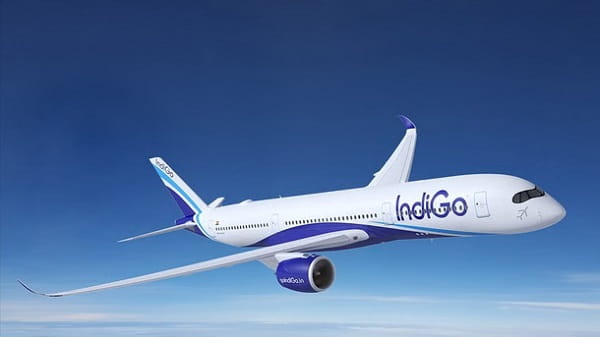
IndiGo, operated by InterGlobe Aviation Limited, commands a dominant 53 to 65 percent share of India’s domestic capacity and passenger traffic depending on the month measured, operating a fleet of more than 437 aircraft as of FY25 and becoming the first Indian carrier to induct the wide-bodied Airbus A321 XLR into its fleet. The airline achieved the highest on-time performance among major carriers at 82.8 percent in a recent reporting month, while placing firm orders for 500 Airbus A320neo family aircraft in 2023 and 30 (later expanded to 60) A350-900 widebody jets in 2025 to support long-haul international expansion.
IndiGo serves domestic and increasingly international travellers with the country’s most extensive route network and largest fleet, and its sustained majority market share alongside genuinely strong on-time performance metrics confirms it as the single most dominant and operationally reliable airline in Indian aviation history.
2. Air India (Tata Group)
Air India, the national flag carrier now under Tata Group ownership following its 2007 merger with Indian Airlines and subsequent 2022 privatisation, held roughly 24.9 to 26.5 percent of domestic market share in early 2026 alongside a 23.6 percent share of international passenger traffic in the most recent fiscal year, making it the leading carrier by international connectivity. The airline took delivery of its first Boeing 787-9 Dreamliner four years after privatisation and has placed orders for 470 Boeing and Airbus aircraft, later expanded by another 100, though the carrier posted losses of around Rs 26,000 crore combined across FY26 and FY27 amid an ongoing operational turnaround.
Air India serves domestic and international travellers as the country’s leading carrier by global connectivity and historic flag-carrier status, and despite significant near-term financial losses during its post-privatisation turnaround, its massive aircraft order book and Tata Group backing confirm it as the second pillar of India’s aviation duopoly with substantial long-term ambitions.
3. Akasa Air
Akasa Air, India’s newest major carrier, has posted the fastest capacity growth in the industry, expanding by 12 percent year-on-year to reach 916,000 monthly seats as of June 2026 while consistently leading the industry in operational efficiency with a passenger load factor around 91 to 92.5 percent, the highest among all major domestic carriers. The airline has partnered with Adani Airports for operations from Navi Mumbai Airport and has placed long-term aircraft orders extending to 2037, positioning it for continued rapid fleet expansion.
Akasa Air serves cost-conscious and efficiency-focused domestic travellers with its rapidly expanding network and industry-leading load factors, and its status as the fastest-growing carrier with genuine long-term aircraft order commitments makes it the most credible candidate to emerge as India’s third major airline force alongside the entrenched IndiGo-Air India duopoly.
4. GMR Airports Limited
GMR Airports has redefined the aerotropolis concept in Asian aviation infrastructure, transforming Indira Gandhi International Airport in Delhi, the country’s busiest airport handling over 79.2 million passengers in FY25, and Rajiv Gandhi International Airport in Hyderabad into global aviation hubs that integrate terminal operations with high-value commercial and retail land banks. The company’s stock has traded actively alongside broader aviation-sector rallies through 2026, reflecting investor confidence in India’s continued airport infrastructure expansion.
GMR Airports serves millions of domestic and international passengers as the operator of two of India’s most significant international gateways, and its pioneering integration of airport operations with commercial real estate development makes it the clearest leader in India’s airport infrastructure segment beyond the airlines themselves.
5. Adani Airports Holdings Limited
Adani Airports has built a rapidly expanding portfolio of six major airports spanning Ahmedabad, Lucknow, Mangaluru, Jaipur, Guwahati, and Thiruvananthapuram, while jointly operating Chhatrapati Shivaji Maharaj International Airport in Mumbai with a 74 percent stake alongside the Airport Authority of India’s 26 percent share, making Mumbai the country’s second-busiest airport with over 52 million annual passengers. The group’s partnership with Akasa Air for operations from the newly developed Navi Mumbai Airport signals its ambitions to build an increasingly integrated aviation ecosystem beyond pure infrastructure ownership.
Adani Airports serves passengers across six major cities plus its stake in Mumbai’s international gateway with rapidly modernising terminal infrastructure, and its aggressive multi-airport expansion strategy combined with new-generation partnerships like its Navi Mumbai tie-up with Akasa Air makes it the most acquisitive and fastest-scaling airport operator in the country.
6. SpiceJet Limited
SpiceJet, one of India’s earliest low-cost carriers, has continued operating despite prolonged financial distress that has created uncertainty around its long-term fleet strategy and overall survival prospects, with its on-time performance and cancellation rates lagging significantly behind larger, better-capitalised rivals. Despite these operational challenges, SpiceJet’s stock has periodically rallied sharply alongside broader positive aviation-sector sentiment, reflecting speculative investor interest in a potential turnaround.
SpiceJet serves budget-conscious domestic travellers on a shrinking but still meaningful network, and while its long-term competitive position remains genuinely uncertain amid persistent financial pressure, its continued operation and periodic stock rallies confirm it as a closely watched, if structurally challenged, participant in India’s airline industry.
7. Air India Express
Air India Express, the low-cost international and domestic arm of the Air India Group, has absorbed the erstwhile AirAsia India and Vistara’s budget operations as part of the Tata Group’s broader airline consolidation strategy, though the carrier reduced capacity by 17 percent in a recent monthly comparison as the parent group works through operational rationalisation. The airline continues to play a critical role in serving cost-sensitive domestic and short-haul international routes, particularly to the Gulf region, as part of the integrated Air India Group network.
Air India Express serves budget domestic and short-haul international travellers, particularly on high-demand Gulf corridors, as the low-cost complement to full-service Air India within the broader Tata Group aviation strategy, and its integration into the consolidated Air India Group network makes it a structurally important, if currently rationalising, contributor to the group’s overall 22 to 25 percent combined market share.
8. Blue Dart Aviation
Blue Dart Aviation, incorporated in 1994 as a subsidiary of Blue Dart Express and 70 percent owned by Deutsche Post since 2017, operates as India’s leading dedicated cargo airline, running a fleet of freighter aircraft from its Chennai hub to serve eight destinations and playing a critical role in the country’s express logistics and time-sensitive air cargo movement. The airline’s dedicated cargo hub at Chennai International Airport, inaugurated in 2018, anchors its position as a specialist in an aviation segment distinct from passenger carriers.
Blue Dart Aviation serves e-commerce, logistics, and express delivery companies with dedicated time-sensitive air cargo capacity across major Indian cities, and its status as the country’s leading pure-play cargo airline, backed by Deutsche Post’s global logistics network, makes it the clearest specialist leader in an aviation cargo segment that continues to grow alongside e-commerce expansion.
9. IRCTC-Adjacent and Regional Connectivity Carriers (Star Air, Fly91, IndiaOne Air)
Regional connectivity carriers including Star Air, Fly91, and IndiaOne Air have emerged to serve smaller markets under the government’s UDAN-RCS regional connectivity scheme, which has expanded the number of operational airports from 49 to well over 150 since its 2016 launch, aiming to reduce the cost of flying and increase the number of routes and flyers across underserved parts of the country. While each of these carriers holds a small individual market share of well under 1 percent, they collectively represent the government’s strategic push to democratise air travel beyond India’s major metro hubs.
These regional carriers serve smaller Tier-2 and Tier-3 cities that larger airlines find commercially unviable to connect directly, and their continued operation under the UDAN-RCS scheme’s route-award incentives makes them structurally important, if individually small, contributors to India’s broader ambition of expanding air connectivity well beyond its established metro corridors.
10. Alliance Air
Alliance Air, the state-owned regional carrier and a subsidiary of Air India before its privatisation, continues to hold a small but stable domestic market share of around 0.4 to 0.6 percent, focusing on regional and short-haul routes that connect smaller cities to major hubs including Delhi’s Indira Gandhi International Airport. The airline’s continued government-linked operational mandate positions it as a policy-driven complement to the private-sector-dominated broader airline market.
Alliance Air serves smaller regional cities with essential short-haul connectivity to major aviation hubs, and its continued state-backed operational role, distinct from the now fully privatised Air India Group, makes it a structurally important, policy-anchored regional carrier supporting India’s broader regional connectivity objectives.
Frequently Asked Questions (FAQs)
Q: Which airline has the largest market share in India?
A: IndiGo commands the largest share of India’s domestic aviation market, ranging between roughly 53 and 65 percent depending on the month and measure used, with the Air India Group holding the second-largest share at around 22 to 27 percent, together forming an effective duopoly that controls between 86 and 91 percent of the domestic market.
Q: Is Akasa Air likely to become India’s third major airline?
A: Industry analysts project that by 2030, IndiGo will operate around 600 active aircraft, the Air India Group around 500, and Akasa Air around 150, suggesting Akasa could emerge as a genuine third major force if it continues taking scheduled aircraft deliveries as planned and improves its financial performance, though the overall duopoly is expected to persist with roughly 85 percent combined fleet share.
Q: Who operates India’s busiest airports?
A: GMR Airports operates Indira Gandhi International Airport in Delhi, the country’s busiest by passenger traffic with over 79 million annual passengers, and Rajiv Gandhi International Airport in Hyderabad, while Adani Airports holds a 74 percent stake in Chhatrapati Shivaji Maharaj International Airport in Mumbai, the country’s second-busiest airport.
Q: How significant is air cargo within India’s aviation industry?
A: Air cargo is an increasingly important segment of Indian aviation, anchored by dedicated carriers such as Blue Dart Aviation, which operates from a purpose-built cargo hub at Chennai International Airport, alongside growing express cargo operations from international logistics players and passenger airlines carrying belly cargo, supporting the rapid growth of e-commerce and time-sensitive logistics across the country.
Q: What is the UDAN-RCS scheme and how has it changed regional air travel?
A: UDAN-RCS, or Ude Desh ka Aam Naagrik, launched by the government in 2016, is a regional connectivity scheme that has expanded the number of operational airports from 49 to well over 150 through multiple award rounds, aiming to reduce airfares and increase the number of routes and flyers to smaller cities that were previously unconnected or underserved by scheduled air travel.